
Clarkston MI Housing Market Trends (2026) |
Clarkston MI housing market trends for 2026 including median home prices, days on market, inventory levels, compete score, and spring forecast insights for buyers and sellers. |
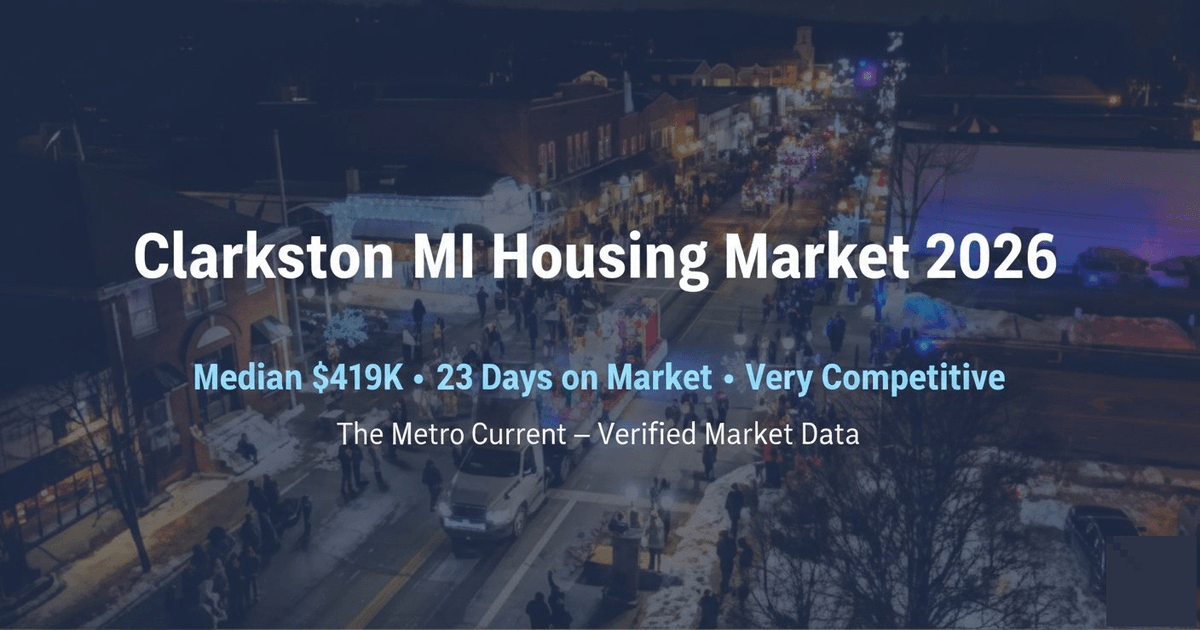
The Clarkston MI housing market continues to show strength in 2026, supported by limited inventory, consistent buyer demand, and the community's enduring quality of life in Oakland County. While broader Southeast Michigan markets are shifting toward balance, Clarkston remains a supply-constrained micro-market where well-priced homes move within weeks and long-term appreciation stays steady.
This isn't a market you can read from statewide headlines. The Village of Clarkston is geographically small — a single premium sale or one modest transaction can swing the monthly median dramatically. Understanding what the data actually shows, and what it doesn't, is what gives buyers and sellers a real edge. This guide breaks down current conditions, how they compare to recent years, the 2026 forecast, and exactly what the trends mean for your situation.
This page serves as the foundational housing market analysis inside The Metro Current’s Clarkston MI Real Estate Guide (2026 Market Overview) and will be updated as new 2026 data becomes available. It works alongside our Clarkston buying guide, selling guide, and mortgage pages to provide complete local real estate coverage.
2026 Clarkston MI Real Estate Market Snapshot
Current data for both the Village of Clarkston and the broader Independence Township market:
Village of ClarkstonMedian Sale Price: ~$305,000 (most recent month) | ~$419,000 (12-month rolling average) Price Per Square Foot: ~$151 Average Days on Market: ~49 days (hot homes: ~22 days) Sale-to-List Ratio: ~3% below list price on average; hot homes selling at or above list Redfin Compete Score: 62 out of 100 — Somewhat Competitive
Broader Clarkston and Independence TownshipMedian List Price: ~$444,000 Village Median — Peak Periods: ~$535,000 (May 2025 — single high-value sale, low-volume month) Price Per Square Foot: $187–$224 depending on property type Average Days on Market: ~73 days Sale-to-List Ratio: 97–98% Michigan State Median: ~$267,500 Michigan Inventory: ~2.8 months supply (balanced market = 4–6 months)
Important context: The Village of Clarkston transacts at low volume — sometimes just one or two homes per month. A single low-value sale like a condo can pull the monthly median down dramatically; a luxury sale spikes it up. The most recent Redfin monthly median of $305,000 reflects exactly this dynamic — one or two lower-priced transactions in a slow winter month, not a market-wide price decline. The 12-month rolling average of $419,000 is the only reliable baseline for this micro-market. The Redfin Compete Score of 62, while lower than the 82 recorded earlier in 2025, similarly reflects winter seasonal slowdown and low transaction volume — not a fundamental shift in market conditions. Source: Redfin Village of Clarkston housing market data, February 2026. Compete Score updated monthly at the beginning of each month. 12-month rolling median from Redfin MLS-based data, Q1 2026.
Clarkston MI vs. Michigan vs. Metro Detroit (2026)
How does the Clarkston MI housing market stack up against statewide and regional benchmarks? The comparison makes Clarkston's premium positioning clear.
Village of Clarkston 12-month rolling median: ~$419,000 — approximately 57% above Michigan statewide median 48346 Zip Code median: ~$384,000 — up 14.6% year-over-year as of November 2025 Michigan statewide median: ~$267,500 — up approximately 3.5% year-over-year Village average days on market: ~49 days trailing; compresses to ~22 days for hot homes in spring Michigan average days on market: ~51 days statewide Village sale-to-list ratio: ~97% average; hot homes at or above list in spring Michigan sale-to-list ratio: ~97% statewide average
Clarkston commands a significant price premium over the Michigan state median — driven by school quality, lake access, walkable downtown character, and structurally constrained supply. The current Redfin Compete Score of 62 reflects the seasonal winter slowdown that this market experiences every year. Spring 2026, consistent with prior years, will see that score rise as buyer activity accelerates from March through May. Source: Redfin Village of Clarkston market data and Michigan statewide housing market data, Q1 2026. 48346 YoY: Redfin zip code report, November 2025.
How Competitive Is the Clarkston MI Housing Market?
Redfin Compete Score: 62 — Somewhat Competitive (February 2026)
The current Redfin Compete Score of 62 places the Village of Clarkston in the Somewhat Competitive category as of February 2026. This is an important number to read correctly — and most buyers and sellers misread it.
A score of 62 in February does not mean Clarkston has become a buyer's market. It reflects the structural reality of how this micro-market behaves in winter: transaction volume drops to 1–2 homes per month, fewer buyers are actively touring, and the metrics Redfin uses to calculate the score — days on market, sale-to-list ratio, competing offers — all soften seasonally. The same dynamic occurs every winter in low-volume markets across Oakland County.
For comparison, the Compete Score was recorded at 82 during more active periods in 2025, placing it in the Very Competitive category. That score is a more accurate representation of what buyers will face when spring inventory arrives in March and competition accelerates through May.
What the current score of 62 means in practical terms: Some homes are receiving multiple offers, but it is not a certainty on every listing the way it was in spring 2025
Average homes are selling for approximately 3% below list price — buyers have modest negotiating room on properties that are not generating immediate competition
Hot homes — move-in ready, accurately priced, desirable location — are still going pending in approximately 22 days and selling at or near list price
Waived contingencies are less common right now than during peak spring competition, giving buyers more protection in their offers
New listings still trigger immediate buyer attention in this tight-inventory environment — prepared buyers should still move quickly on well-priced properties
The limited housing stock within the Village creates a supply-constrained environment that amplifies competition every time a desirable property comes to market regardless of season. Winter simply lowers the temperature slightly — it does not change the structural dynamic. Redfin Compete Score is updated at the beginning of each month. Scores reflect the trailing 12-month period weighted toward recent activity. Source: Redfin Village of Clarkston housing market page, February 2026.
Clarkston MI Home Price Trends 2020–2026
2020–2022: The Pandemic SurgeLike most desirable Oakland County suburbs, Clarkston saw 20–30% price appreciation during the pandemic-era demand surge. Low interest rates, remote work flexibility, and a flight to suburban lifestyle drove demand far beyond already-constrained Clarkston inventory, creating extreme seller's market conditions with Compete Scores consistently in the 80s and 90s.
2023–2024: Normalization Without RetreatAs interest rates rose sharply through 2023 and into 2024, transaction volume slowed and bidding wars largely disappeared. Crucially, Clarkston did not give back its pandemic gains. Prices normalized — they stopped climbing at 20% annual rates — but the underlying value held. This is the hallmark of a fundamentally sound market rather than a speculative one. The Compete Score settled into the 60–75 range during this period, reflecting active but non-frenzied conditions.
2025–2026: Stable, Sustainable AppreciationThe Village of Clarkston recorded a notable year-over-year jump in mid-2025 — median sale prices up 46.6% versus the prior year in one monthly snapshot — but this figure reflects low transaction volume rather than a genuine price surge. A single high-value sale in May 2025 at approximately $535,000 drove that reading. For the broader Clarkston market including Independence Township, the 48346 zip code showed verified appreciation of +14.6% year-over-year as of November 2025 — a real, meaningful number that significantly outperformed the Michigan statewide average of +3.5%.
The current February 2026 monthly median of $305,000 for the Village reflects the opposite dynamic — one or two lower-priced transactions in a low-volume winter month pulling the snapshot figure down. Neither the $535,000 peak nor the $305,000 winter reading is the real story. The 12-month rolling average of approximately $419,000 is.
The bottom line: Clarkston is not in the frenzy of 2021, and it is not in retreat. It is in a period of sustainable, normalized appreciation — the healthiest long-term condition for both buyers and sellers.
Clarkston MI Housing Inventory: Why Supply Stays Tight
Inventory is the most important structural factor in this market — and it has been constrained for years with no near-term relief in sight. Michigan statewide sits at approximately 2.8 months of supply in Q1 2026, well below the 4–6 months that defines a balanced market. Clarkston's inventory is even tighter for three structural reasons that do not resolve seasonally.
Limited new construction: Unlike rapidly expanding suburbs like Novi or Rochester Hills, Clarkston has minimal developable land and little new inventory entering the market. The Village is fully built out. No new pipeline exists. High owner-occupancy and retention: Clarkston homeowners stay long-term, structurally restricting how many listings hit the market in any given season. This is a community people choose to stay in — a stabilizing force most suburbs don't have. No viable substitute in Oakland County: The combination of walkable downtown, Deer Lake access, and top-ranked Clarkston Community Schools is unique. Buyers who want this lifestyle cannot simply pivot to a nearby alternative — which is why demand remains durable across rate cycles.
This supply constraint is the single most important factor supporting Clarkston home values across economic cycles. It is also why the winter Compete Score of 62 will rise again in spring — the buyers do not disappear, they just wait for the right inventory to arrive.
Seasonal Patterns in the Clarkston MI Real Estate Market
Understanding Clarkston's seasonal rhythm is critical to reading the data correctly. The Compete Score, monthly median, and days on market all fluctuate significantly by season — not because the market fundamentals change, but because transaction volume is so low that a handful of sales drives every metric.
Spring — Peak Season (March through May)The strongest selling window and the period when the Compete Score historically rises back toward the 75–85 range. Buyer activity accelerates sharply after Michigan's winter, inventory increases as motivated sellers list, and competition is at its annual peak. Listings with professional photography, accurate pricing, and strong marketing consistently see the best outcomes — including the highest likelihood of multiple offers. Buyers need pre-approval and a decisive offer strategy entering this window. The spring peak is when the market most closely resembles what a Compete Score of 80+ looks like in practice.
Summer — Active but Softening (June through August)Competition softens slightly as families balance school and vacation schedules. Well-priced homes still move. Properties sitting since spring begin showing price flexibility. Early summer offers buyers more negotiating room without a full retreat to buyer's market conditions. Compete Score typically settles in the 65–75 range during this period.
Fall — Motivated Sellers (September through November)Fall listings often come from genuinely motivated sellers — relocation, life events, or properties that didn't sell in spring. Buyer competition drops further, which means prepared buyers can negotiate favorable terms. Inventory thins as sellers pull listings ahead of winter. The Compete Score typically dips into the 55–65 range.
Winter — Low Competition, Serious Buyers (December through February)This is where the market sits right now. The current Compete Score of 62 is a winter reading — not a market-wide signal. Buyers searching in January and February are serious — real need, real timeline. For sellers with compelling listings, winter can produce clean fast offers with minimal competing inventory. The score will rise when spring arrives. Buyers who get pre-approved now and are ready before March will be ahead of the competition that floods in when spring listings hit.
Who Is Buying in the Clarkston MI Housing Market?Redfin migration data reveals the demand base driving this market:
72% of Clarkston homebuyers searched to stay within the metro area. This is a locally rooted demand market, not a national relocation target. That organic loyalty is a structural stabilizing force most suburbs do not have.
28% searched to move outside the area, with outbound interest concentrated in Atlanta, Orlando, and Sarasota — consistent with Michigan’s broader warm-weather migration pattern.
Inbound interest from Chicago and Los Angeles represents a real out-of-state buyer segment — typically buyers familiar with Clarkston who recognize the value relative to those coastal markets and are often cash-capable.
Clarkston is not a relocation hot market. It is a community that people who know it choose to stay in, move within, or specifically seek out. That loyalty-driven demand is one of the reasons the Clarkston MI housing market remains stable across economic cycles — and why even a winter Compete Score of 62 does not translate to buyer leverage on well-priced homes.
What the 2026 Clarkston MI Market Means for BuyersPre-approval is not optional: Even with a current Compete Score of 62, showing up without a fully underwritten pre-approval puts you at a structural disadvantage. When spring competition arrives — and it will — unprepared buyers lose homes to prepared ones. Get pre-approved before February ends.
The Compete Score will rise in spring: The current 62 is a winter reading that reflects seasonal slowdown, not a fundamental shift. Buyers who interpret this as a signal to wait will find themselves competing in a tighter market in March and April.
Subdivision-level pricing matters more than city averages: The gap between Village of Clarkston and outer Independence Township medians can exceed $100,000. Know the specific segment you are targeting and pull the comps for that subdivision, not the zip code.
Move-in-ready homes in the $380,000–$476,000 range move fastest: Expect competition here even in winter. Above $500,000, you have more time but less inventory to evaluate.
Homes past 60 days on market signal negotiating room: Extended days on market is the clearest indicator a seller will move on price — particularly on overpriced or condition-challenged listings. In the current 62-score environment, this leverage is real.
Spring 2026 competition is coming: Be ready before March. Waiting until May means you are already behind the most prepared buyers in this market.
Getting pre-approved is your single most important first step. See our guide to Pre-Approval for Clarkston Home Purchase for a complete walkthrough.
What the 2026 Clarkston MI Market Means for Sellers
Pricing accuracy is critical: The current 62 Compete Score means buyers have slightly more leverage than they did in spring 2025. The 97–98% sale-to-list ratio reflects informed buyers who walk away from overpriced listings. Accurate pricing generates more traffic and better net outcomes than aspirational pricing that causes stagnation.
Do not misread the winter score as a weak market: A Compete Score of 62 in February is normal for this market. It does not mean your home won’t sell — it means you need accurate pricing and strong presentation to capture the serious buyers who are actively searching right now.
Days-on-market stigma kicks in fast: After 30 days, buyers ask what’s wrong. After 60 days, you’re in price-reduction territory. Correct pricing from day one protects both timeline and proceeds — regardless of season.
Presentation drives results in a normalized market: Professional photography, staging, and curb appeal matter more in 2026 than in 2021. Preparation separates average outcomes from strong ones.
Late March through May is your optimal listing window: Spring consistently produces the strongest offers and shortest time on market in Clarkston. If you can time your listing to hit the market in late March, you will be listing into a rising Compete Score rather than a declining one.
Low transaction volume concentrates buyer attention: Sellers in a low-inventory market benefit from fewer competing listings — an advantage that disappears when overpricing or poor presentation drives buyers away.
Wondering what your Clarkston home is worth in today's market? See our guide to What Is My Clarkston Home Worth for a breakdown of how local agents determine value.
Clarkston MI Housing Market Forecast: Late 2026
Looking ahead, the Clarkston MI real estate market is expected to continue modest, stable appreciation through late 2026:
The Redfin Compete Score is expected to rise from its current winter reading of 62 back toward the 75–85 range as spring buyer activity accelerates from March through May, consistent with historical seasonal patterns.
Inventory will remain tight. Limited new construction and strong homeowner retention mean no significant supply relief is likely in the near term.
Buyer competition will be strongest during spring and early summer before softening again in late fall and winter.
A significant price correction is not anticipated under current supply conditions. The structural shortage supporting property values has not been resolved.
Michigan’s statewide 2–4% appreciation forecast represents a floor for Clarkston, which typically tracks at or above the state average due to its premium positioning.
The market will remain competitive but rational — not a return to 2021 bidding wars, but not a sustained buyer’s market either.
Stability, not volatility, defines the 2026 Clarkston MI housing market outlook. The winter Compete Score of 62 is a season — not a trend. Scarcity supports value — and Clarkston's scarcity is structural.
Long-Term Outlook for the Clarkston MI Housing Market
Clarkston's long-term stability rests on structural foundations that are not sensitive to short-term Compete Score fluctuations, interest rate movements, or economic cycles:
Limited land availability and virtually no new construction supply entering the market mean the Village is permanently built out.
Clarkston Community Schools — ranked #46 best school district in Michigan by Niche in 2026 — consistently remains one of Michigan’s top-ranked public districts, creating durable demand from family buyers.
Lake access on Deer Lake, Cranberry Lake, and the surrounding lake system provides a lifestyle asset with no substitute in the immediate area.
The walkable historic downtown — a federally designated National Historic District — is increasingly rare and highly sought-after in suburban Michigan.
I-75 corridor positioning enables manageable commutes to Auburn Hills, Troy, and Pontiac employment centers.
Clarkston is not a high-volume market. It is a scarcity market. And scarcity supports value — through cycles, through rate changes, through seasonal Compete Score fluctuations, and through whatever the broader economy does next.
Frequently Asked Questions — Clarkston MI Housing Market
Is now a good time to buy a home in Clarkston MI? For buyers with stable finances and a 3–5 year horizon, yes. The current Redfin Compete Score of 62 and winter market conditions give buyers slightly more negotiating room than spring will. Clarkston's fundamentals — constrained inventory, strong schools, consistent demand — support long-term value. Waiting for significant price drops is unlikely to be rewarded given the structural supply shortage. The bigger risk for buyers is missing the spring inventory window while waiting for conditions that may not materialize.
Are Clarkston MI home prices dropping in 2026? No. The most recent monthly median of $305,000 reflects a single or small number of lower-priced sales in a low-volume winter month — not a market-wide price decline. The 12-month rolling average of approximately $419,000 is the accurate baseline. The Clarkston MI real estate market is stable to modestly appreciating in early 2026. Michigan statewide is forecast to see 2–4% appreciation through 2026, and Clarkston's supply constraints support that trajectory locally.
How fast are homes selling in Clarkston MI? Within the Village of Clarkston, the current trailing average is approximately 49 days, with hot homes going pending in approximately 22 days. For the broader Clarkston market including Independence Township, the average rises to approximately 73 days, reflecting higher price points rather than soft demand. Accurately priced, move-in-ready homes consistently beat both averages regardless of season.
Are Clarkston homes selling above asking price? In the current winter market, the average sale-to-list ratio is approximately 97%, with most homes selling about 3% below asking. Some highly desirable homes — move-in ready properties near downtown or with lake access — still attract offers at or near list price. Buyers have modest negotiating room right now, especially on properties past 45 days on market. This leverage will narrow significantly when spring competition arrives.
What is the Redfin Compete Score for Clarkston MI? The current Redfin Compete Score for the Village of Clarkston is 62 out of 100 — Somewhat Competitive — as of February 2026. This is a winter seasonal reading that reflects reduced transaction volume and slower buyer activity typical of January and February in this market. During spring and summer 2025, the score reached 82 — Very Competitive. The score is updated at the beginning of each month and will rise again as spring buyer activity accelerates from March through May. Both readings are accurate for their respective seasons — the 62 does not represent a permanent shift in market competitiveness.
How have Clarkston MI home prices changed over 5 years? Clarkston saw 20–30% appreciation during the pandemic-era surge of 2020–2022. Since then, prices have normalized and the 48346 zip code showed verified year-over-year appreciation of +14.6% as of November 2025 — significantly above the Michigan statewide average of +3.5%. The market has retained its pandemic gains rather than giving them back — reflecting underlying demand strength, not speculative inflation.
Is Clarkston MI a buyer's or seller's market in 2026? Clarkston currently sits closer to a balanced-to-slight-seller's market with a winter Compete Score of 62. Conditions are more favorable for buyers right now than they will be in spring — giving buyers slightly more time and negotiating room than the peak season provides. Well-priced, move-in-ready homes in desirable subdivisions still attract competitive activity even in winter. By March, the balance will shift back toward sellers as buyer competition accelerates.
Is Clarkston MI a good place to invest in real estate? Clarkston's limited supply, top-ranked schools, and strong community identity make it a stable long-term hold. Investors should expect lower transaction volume — this is not a high-turnover flip market. Long-term appreciation and rental income on quality properties are the realistic return drivers. The structural supply constraints that make this a strong buyer market also protect investor value across economic cycles.
Related Clarkston MI Real Estate GuidesThis Clarkston MI housing market analysis anchors The Metro Current's full Clarkston real estate hub — including neighborhood pricing data, buyer strategy, seller guidance, and mortgage resources. Continue your research here:
Clarkston MI Real Estate Guide (2026 Market Overview) Is Clarkston a Buyer’s or Seller’s Market? What Is My Clarkston Home Worth?
Bottom Line: The 2026 Clarkston MI Housing Market
The 2026 Clarkston MI housing market is supply-constrained, competitive but rational, and stabilized after pandemic price spikes — supported by structural fundamentals that hold across economic cycles.
The current Redfin Compete Score of 62 is a winter reading, not a trend. It will rise when spring arrives. The monthly median of $305,000 is a low-volume snapshot, not a price decline. The 12-month rolling average of $419,000 and the 48346 zip code's +14.6% year-over-year appreciation are the numbers that tell the real story.
Clarkston is a scarcity-driven Oakland County micro-market where preparation, pricing strategy, and timing determine outcomes. Buyers who arrive pre-approved before March and understand subdivision-level pricing will find real opportunities in the current winter window. Sellers who price accurately and present well will achieve strong results — and sellers who list in late March will be listing into rising competition rather than declining interest.
As additional Clarkston MI housing data becomes available throughout 2026, this page will continue expanding to reflect updated pricing trends, inventory shifts, and seasonal demand patterns.
The Metro Current builds city-based housing authority hubs designed to deliver hyper-local real estate clarity for communities like Clarkston, MI.
|
0 Comments
Join the conversation
Be the first to comment
Share your thoughts above.